Table of Contents
THIS VERSION IS A DRAFT AND HAS NOT BEEN OFFICIALLY APPROVED
GOV1: PROCEED Program Governance and Responsibilities
Objective
- Define the rules for decision-making to ensure the effective implementation of the PROCEED program and provide clear guidance for reaching the targeted objectives.
- Provide a general description of the Steering Committees and Task Forces, outlining their roles and responsibilities.
Governance Scheme
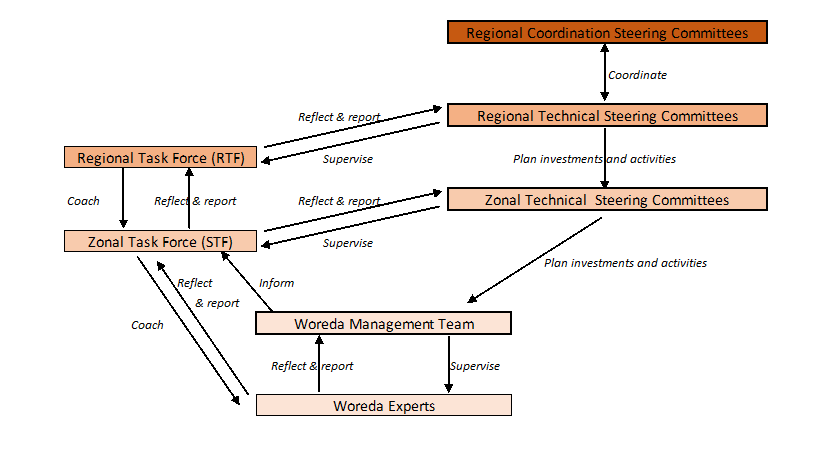
The governance scheme of the PROCEED program includes:
- A Regional Steering Committee oversees the PROCEED program coordination and manages reporting to the AFD.
- Two Regional Technical Steering Committees (Water Service and Agriculture) handle operational decision-making.
- A Regional Task Forces supports the implementation of PROCEED program activities by providing technical guidance and ensuring coordination across Zones.
- Zonal Steering Committees manage sectoral decision-making at the Zone level.
- Zonal Task Forces oversee the execution of activities within their respective Zones and provide operational support to Woreda teams.
- Operational Woreda Management Teams operate at the Woreda level, combining both steering and task force functions by overseeing decision-making while ensuring the implementation of activities.
Governance scheme
Users of the procedure:
All participants of the Steering Committees and Task Forces.
Steering Committees
Steering Committees provide strategic oversight and ensure the effective coordination and implementation of the PROCEED program at the different administrative levels. They align decision-making processes with program objectives, manage risks, and facilitate collaboration among stakeholders.
Key responsibilities
Each Steering Committee serves as a platform for reviewing progress, addressing challenges, and making key decisions regarding technical, financial, and operational aspects. While the specific structure and responsibilities vary at each administrative level (Region, Zone or Woreda - under the Woreda Management Team), their core function remains the same: to guide implementation, ensure accountability, and maintain alignment with the strategies.
The RTF Coordinators are responsible for ensuring the organisation of Steering Committee meetings at the regional level, according to the MoP, and for supporting the ZTF Coordinator in organising the Steering Committees at the zonal level.
Decision-making process
- Steering Committee members actively participate in decision-making.
- The Steering Committee is chaired by the highest-ranking official unless an alternative chair is appointed by decision of the committee.
- Task Force coordinators act as secretaries, ensuring documentation and follow-up on decisions.
- Observers can be invited when deemed necessary to provide expertise and technical input to support informed decision-making.
- A quorum of at least 60% of members (present or represented) is required for decisions to be made.
- Decisions are made by consensus whenever possible. If a vote is necessary, a decision is adopted if supported by more than 50% of the members. In case of a tied vote, the Chairperson’s vote counts double.
Inputs and outputs
Inputs:
- Agendas and preparatory documents provided in advance by the responsible coordinators.
- Technical and financial reports to inform discussions and decision-making.
- Recommendations from Task Forces and relevant stakeholders.
Outputs:
- Official minutes documenting decisions, recommendations, and action points.
- Strategic guidance for the PROCEED program implementation at each level.
- Follow-up actions and responsibilities assigned to relevant stakeholders.
A detailed description of the composition and specific responsibilities of each Steering Committee at Region, Zone and Woreda (Woreda Management Team) levels is provided in the Annexes (Annex GOV1 – A1).
Task Forces
Task Forces are specialised operational teams responsible for the technical and financial implementation of the PROCEED program. Unlike Steering Committees, which focus on strategic oversight, Task Forces are action-oriented and play a key role in translating decisions into concrete actions at different administrative levels. They ensure that programme activities are effectively executed, monitor progress, and provide technical support to the different stakeholders.
Each Task Force operates at its respective level (Region, Zone or Woreda - under the Woreda Management Team) with the primary objective of ensuring that implementation aligns with the programme's procedures and objectives.
Key responsibilities
- Oversee the implementation of PROCEED activities in their respective administrative level.
- Provide technical and operational support to field experts and stakeholders.
- Facilitate coordination between different levels of implementation.
- Act as secretaries for the Steering Committees, preparing agendas, presenting progress reports, and documenting decisions.
- Identify operational challenges and propose solutions or report issues to the appropriate Steering Committee.
- Implement capacity-building initiatives to strengthen technical expertise within the program.
Decision-making and coordination
- Task Forces make operational decisions within their mandate, ensuring alignment with the PROCEED program Procedures and Implementing Documents, serving as guidelines.
- When higher-level decisions are required, Task Forces report matters to the appropriate Steering Committee.
- They coordinate closely with field experts to ensure activities are implemented according to defined Procedures, Implementation Documents and technical standards.
Inputs and outputs
Inputs:
- Technical and financial reports to assess progress and challenges.
- Feedback from field experts and stakeholders.
- Operational data on program implementation and performance indicators.
Outputs:
- Implementation reports and recommendations for Steering Committees.
- Adjustments to operational strategies to improve effectiveness.
- Documentation of key actions taken and lessons learned.
A detailed description of the composition and specific responsibilities of each Task Force at Region, Zone and Woreda (Woreda Management Team) levels is provided in the Annexe RH – A1.
Exchange of experiences between the two Regions
Although both Regions operate under a common MoP and share the same objectives, each Region manages the PROCEED program independently, with no joint steering committee in place.
However, the two Regions are encouraged to regularly exchange their experiences related to the PROCEED program implementation through appropriate means such as meetings, field visits, and communication events.
The Technical and Administrative Assistance teams support and facilitate the organisation of these exchanges to encourage cross-learning and collaboration.
Technical and Administrative Assistances
The PROCEED program will be supported by two key types of assistance: a Technical Assistance and an Administrative Assistance, working together to strengthen local capacities and ensure effective program implementation. Their roles and responsibilities are described in the Assistance Procedures.